<?xml version="1.0" encoding="utf-8"?><feed xmlns="http://www.w3.org/2005/Atom" ><generator uri="https://jekyllrb.com/" version="3.10.0">Jekyll</generator><link href="sjpearthjustice.github.io/feed.xml" rel="self" type="application/atom+xml" /><link href="sjpearthjustice.github.io/" rel="alternate" type="text/html" /><updated>2025-06-05T17:14:25+00:00</updated><id>sjpearthjustice.github.io/feed.xml</id><title type="html">SJP Earth Justice</title><subtitle>Blog posts, updates and other writing from the Earth Justice team at St. James&apos;s Piccadilly.</subtitle><entry><title type="html">Butterfly</title><link href="sjpearthjustice.github.io/breathe/poetry/2025/06/05/butterfly-poem.html" rel="alternate" type="text/html" title="Butterfly" /><published>2025-06-05T00:00:00+00:00</published><updated>2025-06-05T00:00:00+00:00</updated><id>sjpearthjustice.github.io/breathe/poetry/2025/06/05/butterfly-poem</id><content type="html" xml:base="sjpearthjustice.github.io/breathe/poetry/2025/06/05/butterfly-poem.html"><![CDATA[<center>
<h1>Butterfly</h1>

Swarmed power swept by a fierce tail-wind<br />
high over chimneys, in flight<br />
from poison-fume<br />
smoke-gloom<br />
that pinned<br />
to starving death<br />
these beings winged with light<br />
who now break free and whirl above the earth<br /><br /><br />
A miracle was present in their making:<br />
egg, furry crawling larva, sheath.<br />
When were they birthed?<br />
Or we?<br />
To not-be<br />
pulped catafly<br />
pent inside a chrysalis, breaking<br />
out with damp and scarcely-quivering wings<br /><br />
We look for them in summer, never dreaming<br />
these gleaming peacock-flies, so light-<br />
weight, so frail<br />
could sail<br />
at such a height<br />
nine thousand miles, with rests<br />
to feed, breed; each generation streaming<br />
closer towards home, towards their own land-nest<br />

</center>]]></content><author><name>Diane Pacitti</name></author><category term="breathe" /><category term="poetry" /><summary type="html"><![CDATA[Butterfly]]></summary></entry><entry><title type="html">Creatures of Air?</title><link href="sjpearthjustice.github.io/breathe/2025/05/25/creatures-of-air.html" rel="alternate" type="text/html" title="Creatures of Air?" /><published>2025-05-25T00:00:00+00:00</published><updated>2025-05-25T00:00:00+00:00</updated><id>sjpearthjustice.github.io/breathe/2025/05/25/creatures-of-air</id><content type="html" xml:base="sjpearthjustice.github.io/breathe/2025/05/25/creatures-of-air.html"><![CDATA[<p>One day an old and wise fish is swimming along when she meets a couple of young fish coming the other way. The elder fish calls out ‘Morning! How’s the water down your way?’ The young ones greet the elder respectfully, ‘Morning, yes, great thanks!’. When they are out of earshot they turn to each other and ask ‘What the &amp;?@#! is water?’.</p>

<p>Our fishy teachers in the story show that to become aware of the nature of the medium in which we live, we need to develop some consciousness.  Medium is so complete and pervasive we can’t imagine being outside it. We approach it remotely, descriptively via its effects. Chatting about the weather, the oldest social glue in the book, is indirectly commenting on our medium. Unless we strap on some big tanks and go underwater or into space it’s very difficult for us to have access to air-as-medium except from a subjective perspective of embeddedness within it. Fish can’t pop out onto the beach and describe the sea without dying in the attempt.</p>

<p>As landlubbers, we are ‘pneumatic fish’, belonging to and in some sense described by, the air. The atmosphere is our medium, our most intimate connection with the world around us. We swim in it, both inside and outside our bodies, our lungs never ceasing their rhythmic swell and ebb, 12 to 20 times every minute of our lives. Air is gaseous inside our lung spaces before it dissolves or is chemically bound in our blood. Sophisticated boundary mechanisms manage these transformations deep in the lungs, mirroring fishy gills continually interacting with water to extract gases. Where outside medium ends and inside begins is not straightforward. For divers with ‘the bends’, pressure changes can cause those dissolved gases to come out of solution and, unhelpfully for the diver, form bubbles on the inside. We are porous to medium, continuous with environment. As Mary Frohlich puts it, ‘A body is … not a self-generated individual emerging simply from its own interiority; the body is a relational event, is relationship itself, with no rigid boundary absolutely separating one from another’</p>

<hr />
<p></p>

<p>What exactly is air? A clue is in the ‘exactly’ – it’s not exactly anything.  By one definition it’s a mixture, meaning the composition can vary. We are conditioned to think that as animals we ‘breathe in oxygen and breathe out carbon dioxide’, defining air in an entirely utilitarian way that focuses on what we can get out of it. A product of our heroic, individualistic narratives. More ‘ecologically’, we could say that each inbreath contains 79% nitrogen, 20% oxygen, 1% argon and some traces of other stuff including carbon dioxide; and each outbreath contains 79% nitrogen, 16% oxygen, 1% argon and 4% carbon dioxide. We experience some very weird effects if the percentage of oxygen or carbon dioxide deviates from the narrow range we millions of years of evolution have fine-tuned us to. And then there’s the variable quantity of water vapour flowing in and out with every breath, depending on whether we’re in the shower, the desert or somewhere in between. Perhaps we should say we breathe a stream of nitrogen which is carrying a few other gases and tempered with steam.</p>

<blockquote>
  <p>Carrier, matrix, medium. It seems very hard for us to consider these environmental contexts as important or integral to a system, we love to extract and focus on ‘active ingredients’.</p>

  <p>A classic example is ‘junk’ DNA. Thankfully this highly disrespectful term has thankfully been superseded and replaced with the word ‘intron’, which essentially refers to the vast majority of DNA that is non-coding, i.e. doesn’t provide a template for a protein that produces a characteristic in a living thing. So what’s it DOING taking up all that space in cells?</p>

  <p>And what’s that vast reservoir of inert nitrogen DOING in the atmosphere? Maybe we need a different question.</p>
</blockquote>

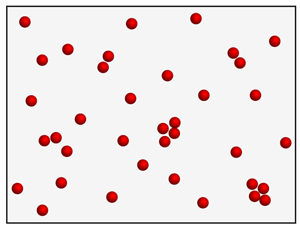
<p><img src="https://www.scientia.ro/images/A2_2020/molecule-aer-coliziune.png" style="float: right; width:40%; margin-left: 15px" alt="Red particles scattered in an otherwise empty white box." /></p>

<p>A classic trope for cajoling children into accepting that air consists of lots of particles with big gaps between them is to offer them a ‘box of air’ diagram like this one, explain that the dots represent molecules of gases, then get them to think about what’s between the molecules. Whereupon many fall into the elephant trap set for them and say ‘air’. The task then becomes thinking about empty space (which is not nothing in itself, and also includes sub-atomic particles whizzing about in the gaps). Perhaps we are vacuum-beings rather than pneumatic beings as there is much more ‘empty’ space in our primary medium than anything else.</p>

<p>Nevertheless, this particular model is an excellent explanatory one that has served us well for a couple of hundred years, ever since John Dalton, growing his scientific mind in Manchester just before the industrial revolution, first proposed his atomic theory. Dalton’s family were Dissenters – Quakers - so John was not permitted to attend university at the end of the 18th century, and was therefore able to freely think outside the box…</p>

<blockquote>
  <p>Ideas from inside the box persist when scientific thinking is evolving and it’s not always helpful to simply dismiss them. Dialogue between models is sometimes as fruitful as Copernican revolutions, and there’s nothing like a dose of cognitive dissonance to deepen reflection.</p>

  <p>Prior to Dalton’s era, the classical elements of earth, air, water and fire were very much inside the acceptable thinking box for many and diverse cultures - according to Wikipedia these included Greece, Angola, Tibet, India and Mali. These four elements provided a strong framework for understanding the world, sometimes with the addition of ‘aether’ which served a multitude of roles: accounting for empty space, vibrating to generate light, and making space for a spiritual dimension. The four elements patterning in our minds continues in parallel and interaction with atomic theory.</p>
</blockquote>

<p><img src="https://static.vecteezy.com/system/resources/thumbnails/003/357/588/small_2x/illustration-of-lung-tree-environment-and-medicine-photo.jpg" style="float: left; width:40%; margin-right: 15px" alt="An illustration of lungs, but the lungs are formed of two leafless trees upside-down and branching out like alveoli. The trees are dark coloured, but highlighted in red and yellow. The background is a blue-white sky." /></p>

<p>Back to those boundary mechanisms. Lungs are like huge leaky parachutes, folded, folded and folded again in order to fit a very thin membrane the size of half a tennis court into a human thorax. The macro-impression is astonishingly tree-like. Branching is integral to multi-cellular life.</p>

<p>The alveoli which do the actual gas exchange are tiny sacs, looking like bunches of grapes in the textbooks, dangling at the ends of the fantastical tubular network that channels air downwards and inwards. The word alveolus is Latin for a small cavity, basin or hollow. It’s the diminutive of alvus, a basin, belly, womb or other cavity, and also the hold of a ship. So a little space for holding substance of great value, like cupped hands.</p>

<p>Each alveolus is more-or-less spherical, the geometric shape that maximizes surface area for an enclosed volume, prioritising edges rather than the container itself. Their enclosing membranes are one flattened cell thick and always wet, the better to dissolve gases and channel them from the airy lung spaces (or better, ‘steamy’ as its very humid in there) to the capillary net on the inside.</p>

<blockquote>
  <p>We are closer to our fishy ancestors than we think – at all the surfaces where we are most intimately in contact with our outside medium, water washes over our cells, caressing, supplying and cleaning them. We are still aquatic beings after all, the ocean travels with us: our guts contain oceans of micro-organisms; an amniotic sac is an ocean-bearing cradle; our eyes are small, crystal-clear oceans; blood is a river of ocean; and every tiny cell is a droplet of ocean in itself.</p>
</blockquote>

<p>Once the air is carefully managed across the alveolar membranes, oxygen is delivered to every cell in our bodies and carbon dioxide is efficiently removed. Every single one of billions of cells over a 2-meter body length and 20cm depth of tissue! Whether they are muscle cells lodged in a middle toe, white blood cells on the move in and out of capillaries, or β cells in the pancreatic Islets of Langerhans pumping out insulin, every single cell gets what it needs to fulfil its vocation. What a model of welfare and economic flourishing: to each according to their needs, from each according to their gifts.</p>

<p>Breathe in, breathe out… otherwise known as Praise Be!</p>

<div style="text-align: right">
Deborah Colvin 2025
</div>]]></content><author><name>Deborah Colvin</name></author><category term="breathe" /><summary type="html"><![CDATA[One day an old and wise fish is swimming along when she meets a couple of young fish coming the other way. The elder fish calls out ‘Morning! How’s the water down your way?’ The young ones greet the elder respectfully, ‘Morning, yes, great thanks!’. When they are out of earshot they turn to each other and ask ‘What the &amp;?@#! is water?’.]]></summary></entry><entry><title type="html">Two Poems About Air</title><link href="sjpearthjustice.github.io/breathe/poetry/2025/05/25/two-poems.html" rel="alternate" type="text/html" title="Two Poems About Air" /><published>2025-05-25T00:00:00+00:00</published><updated>2025-05-25T00:00:00+00:00</updated><id>sjpearthjustice.github.io/breathe/poetry/2025/05/25/two-poems</id><content type="html" xml:base="sjpearthjustice.github.io/breathe/poetry/2025/05/25/two-poems.html"><![CDATA[<p>The poem extract below is taken from a longer poem inspired by the Jewish tradition of the Tzadik Nistar: the concealed righteous ones. These are the 36 hidden people, renewed in each generation, whose humble and holy existence sustains the world.  Their identities are unknown to each other, and each is unaware their own crucial role, but the belief is that if even one was missing, the world would come to an end.</p>

<p>I am fascinated by this idea. It made me wonder: who are the people who, like an invisible glue, hold the human and more-than-human world together? In the eighteenth century a leading rabbinical writer said that they might be wood-choppers or water-drawers. Perhaps now they might be carers, or small-scale ecological farmers, or an indigenous person faithfully resisting the desecration of the land they love.</p>

<p>If we turn to the more-than-human world, who would be our choice for the Tzadik Nistar?  To even consider this makes us realise how inter-connected all earth-beings are, how to take away just one sets off chains of reactions which affect the whole earth.  If we are naming ecological heroes, keystone species come to mind. Some, such as sea otters, elephants and wolves, are highly visible, but bees would be a good example.  In my poem I write about ‘weeds’ that transform desecrated soil, and fungi, literally hidden below-ground. And I write about air.</p>

<p>Out of the four classical ‘elements’ of earth, water, air, air is the invisible member, a pre-condition for life that for most of human history has been taken for granted:</p>

<center>
<img src="/assets/d-pacitti-pentecost-2025.jpg" width="70%" alt="A poem written over a photograph of a clear blue sky, tinged with pink at the bottom. The full text is given below." />
</center>
<details><summary>Full text of poem</summary>
What do our eyes encounter all the time<br />
and pass through?<br /><br />

What is closer than our skin<br />
passing through our bodies;<br />
yet also distant<br />
and Invisible?<br /><br />

The same protector<br />
Who With gravity<br />
fastens the seas and rivers<br />
to this earth;<br /><br />

the same shield<br />
who envelopes us, who clings like an embrace<br />
to preserve life-heat<br />
to shield from harmful rays;<br /><br />

our eyes stopped at the clouds<br />
the visible signs<br />
or disappeared in an infinity of blue;<br />
while, subtly layered, it was all around:<br /><br />

a vulnerable halo<br />
we ignored:<br />
then bored a hole<br />
with a vomit of black smoke.<br /><br />

Diane Pacitti, 2025
</details>
<p><br /></p>

<p>It is chilling that we are only just beginning to recognise the presence and significance of fungi, or the ozone layer, at the very moment we are destroying the biosphere which they sustain. Suddenly the Jewish mystic belief that the removal of just one member of the hidden holy ones will precipitate the end of the world sounds alarmingly relevant to the 21st century.</p>

<p>My second poem was published in <strong><em>Fixing Earth: Africa, UK and Ireland Writers Anthology Vol. 2</em></strong>, edited by Tendai Mwanaka.</p>

<p>The first verse focusses on air, but I am offering the whole poem because ecological breakdown in one part affects the whole earth, and language struggles to catch up.</p>

<h2 id="revolt-of-the-elements">Revolt of the Elements</h2>

<p>The air is weary<br />
of ghosting the human world. It is tired of hosting<br />
a phantom-earth built out of factory-smut, <br />
flaked skin and car-fart. It resents being used<br />
as a human lavatory: this path of birds;<br />
this wind-way of seeds. Now it twists and roars<br />
in hurricanes. It hurls itself at impediments.</p>

<p>The water<br />
doesn’t know its place any more. Its freedom-flow<br />
is kettled into plastics, implicated<br />
in death-camps which capture, starve and choke<br />
its own offspring. It remembers the planet<br />
as a womb of silent water. Fouled, thwarted,<br />
its swelling body tears at the upstart land.</p>

<p>The words refuse<br />
to work for us any more. We called these rocks<br />
a coast, to pin down our nation-state:<br />
now they are muddy flux. The caps of our globe<br />
rage towards us as sea. Now names shrink back <br />
to breath and spittle. Ancient presences<br />
refuse to be nouns, and become verbs.<br />
<br /></p>

<center>
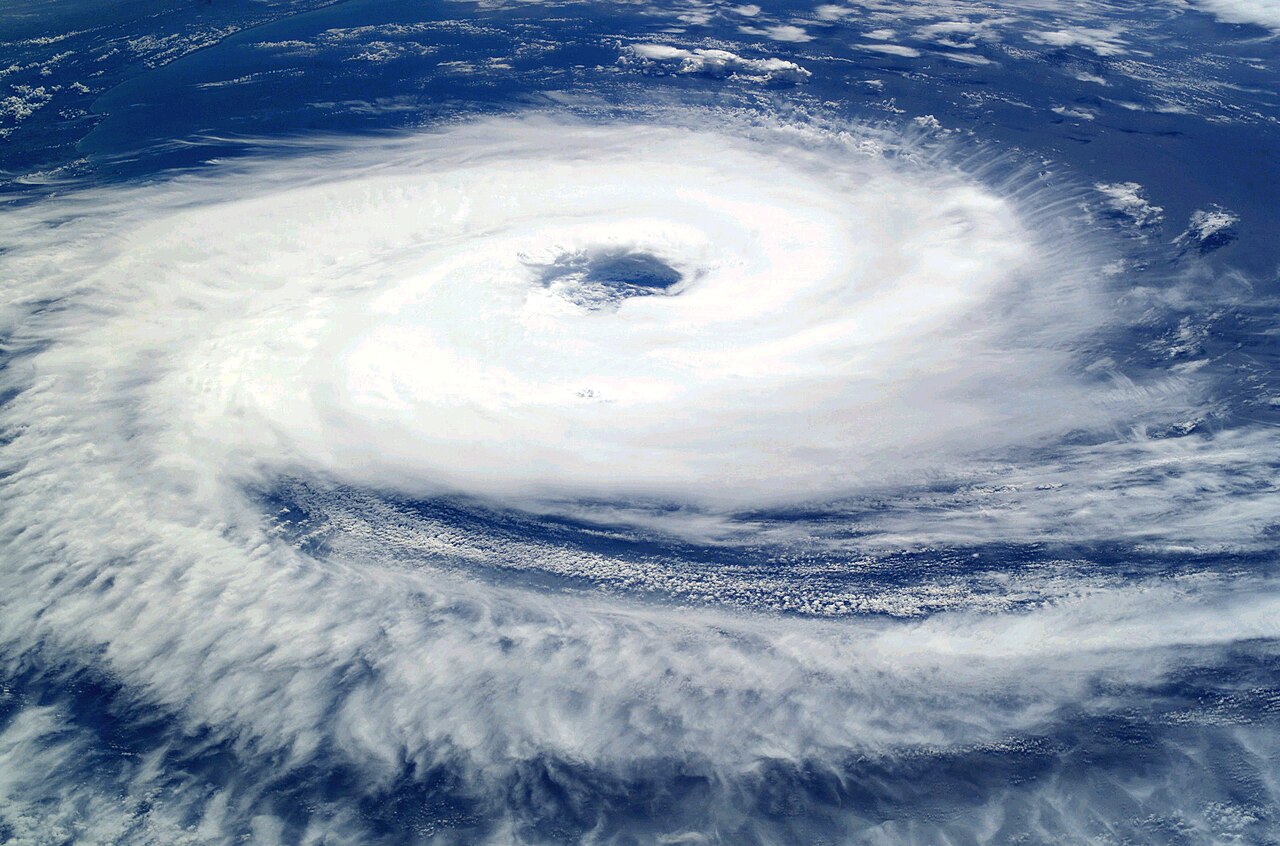
<img src="https://upload.wikimedia.org/wikipedia/commons/thumb/8/89/Cyclone_Catarina_from_the_ISS_on_March_26_2004.JPG/1280px-Cyclone_Catarina_from_the_ISS_on_March_26_2004.JPG" alt="An image of hurricane Katrina taken from the International Space Station." width="400px" />
</center>
<p><br /></p>
<div style="text-align: right">
Diane Pacitti 2025
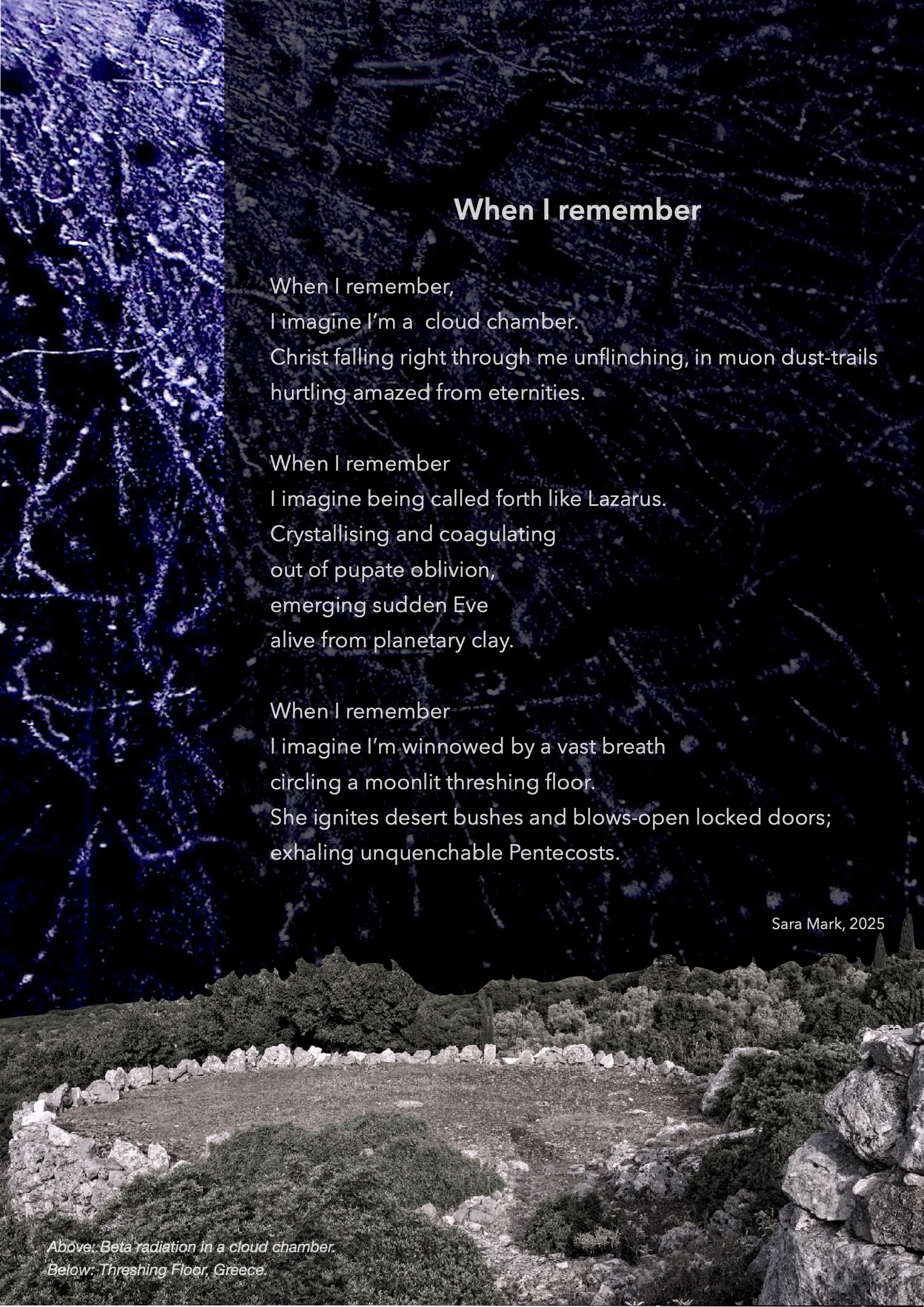
</div>]]></content><author><name>Diane Pacitti</name></author><category term="breathe" /><category term="poetry" /><summary type="html"><![CDATA[The poem extract below is taken from a longer poem inspired by the Jewish tradition of the Tzadik Nistar: the concealed righteous ones. These are the 36 hidden people, renewed in each generation, whose humble and holy existence sustains the world. Their identities are unknown to each other, and each is unaware their own crucial role, but the belief is that if even one was missing, the world would come to an end.]]></summary></entry><entry><title type="html">When I remember</title><link href="sjpearthjustice.github.io/breathe/poetry/2025/05/25/when-i-remember.html" rel="alternate" type="text/html" title="When I remember" /><published>2025-05-25T00:00:00+00:00</published><updated>2025-05-25T00:00:00+00:00</updated><id>sjpearthjustice.github.io/breathe/poetry/2025/05/25/when-i-remember</id><content type="html" xml:base="sjpearthjustice.github.io/breathe/poetry/2025/05/25/when-i-remember.html"><![CDATA[<p><img src="/assets/s-mark-pentecost-2025.jpg" alt="A poem written over two photographs. At the top, beta radiation trails in a cloud chamber are shown in purple. At the bottom, an old threshing-floor in Greece surrounded by shrubs and trees. The full poem text is given below." /></p>
<details><summary>Full text of poem</summary>
<h2>When I remember</h2>
When I remember,<br />
I imagine I'm a  cloud chamber.<br />
Christ falling right through me unflinching, in muon dust-trails<br />
hurtling amazed from eternities.<br /><br />

When I remember<br />
I imagine being called forth like Lazarus.<br />
Crystallising and coagulating<br />
out of pupate oblivion,<br />
emerging sudden Eve<br />
alive from planetary clay.<br /><br />

When I remember<br />
I imagine I'm winnowed by a vast breath<br />
circling a moonlit threshing floor.<br />
She ignites desert bushes and blows-open locked doors;<br />
exhaling unquenchable Pentecosts.<br /><br />

Sara Mark, 2025
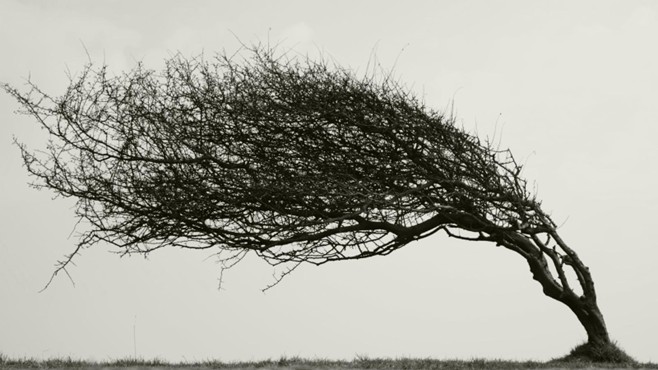
</details>]]></content><author><name>Sara Mark</name></author><category term="breathe" /><category term="poetry" /><summary type="html"><![CDATA[Full text of poem When I remember When I remember, I imagine I'm a cloud chamber. Christ falling right through me unflinching, in muon dust-trails hurtling amazed from eternities.]]></summary></entry><entry><title type="html">Eco Contemplative Liturgy: wind and breath</title><link href="sjpearthjustice.github.io/breathe/liturgy/2025/03/23/eco-cont-lit.html" rel="alternate" type="text/html" title="Eco Contemplative Liturgy: wind and breath" /><published>2025-03-23T00:00:00+00:00</published><updated>2025-03-23T00:00:00+00:00</updated><id>sjpearthjustice.github.io/breathe/liturgy/2025/03/23/eco-cont-lit</id><content type="html" xml:base="sjpearthjustice.github.io/breathe/liturgy/2025/03/23/eco-cont-lit.html"><![CDATA[<p><img src="/assets/tree.jpg" style="display: block; margin-left: auto; margin-right: auto; width: 80%;" alt="A black and white image of a tree, bent over hard to the left. It looks like it might have grown this way due to very strong winds. There are no leaves on the tree, and there is grass visible at the bottom of the frame." /></p>

<h2 id="gathering">Gathering</h2>

<p>We begin by settling ourselves on the seats, slowly stilling our bodies. We hear the sound of traffic, whose polluting fumes, heavier than air, are sinking into low places. Now we centre our attention here, at this moment in St. James’s garden. We feel the air on our faces, perhaps a movement of wind. We focus on our breathing, in and out, noting how our nostrils and mouths give form to the air, making a tiny wind in and out, in and out. We breathe with the grasses. We in-spire and ex-pire with the trees.</p>

<p>As we breathe in and out with plants and trees and other beings, we co-inspire each other. We are inhaling and exhaling the breath with which God quickened life in a formless void.</p>

<h2 id="readings">Readings</h2>

<blockquote>
  <p>In the beginning when God created the heavens and the earth, the earth was a formless void and darkness covered the face of the deep, while a wind from God swept over the face of the waters. Then God said, ‘Let there be light’; and there was light.</p>

  <p>– Genesis 1 v 1-3</p>
</blockquote>

<blockquote>
  <p>Nothing is more common to the diverse indigenous cultures of the earth than a recognition of the air, the wind, and the breath, as aspects of a singularly sacred power… many indigenous peoples construe awareness, or ‘mind’ not as a power that resides inside their heads, but rather as a quality they themselves are inside of.</p>

  <p>– David Abram: The Spell of the Sensuous</p>
</blockquote>

<blockquote>
  <p>I am the fiery life of the essence of God; I am the flame above the beauty in the fields; I shine in the waters; I burn in the sun, the moon, and the stars. And with the airy wind, I quicken all things vitally by an unseen, all-sustaining life.</p>

  <p>– Hildegarde of Bingen</p>
</blockquote>

<blockquote>
  <p>The winds are burdened by the utterly awful stink of evil, selfish goings-on… The air belches out the filthy uncleanliness of the peoples.</p>

  <p>– Hildegarde of Bingen</p>
</blockquote>

<blockquote>
  <p>Wild Spirit, which art moving everywhere;<br />
Destroyer and preserver; hear, oh hear! ..</p>

  <p>If I were a dead leaf thou mightest bear;<br />
If I were a swift cloud to fly with thee;<br />
A wave to pant beneath thy power, and share</p>

  <p>The impulse of thy strength, only less free<br />
Than thou, O uncontrollable! If even<br />
I were as in my boyhood, and could be</p>

  <p>The comrade of thy wanderings over Heaven,<br />
As then, when to outstrip thy skiey speed<br />
Scarce seem’d a vision; I would ne’er have striven</p>

  <p>As thus with thee in prayer in my sore need.</p>

  <p>– Percy Bysshe Shelley: Ode to the West Wind</p>
</blockquote>

<h2 id="meditation-15-minutes">Meditation (15 minutes)</h2>

<p>We take the rhythms of our breathing, with the tiny winds it sucks into our bodies and exhales into the air, into the garden or our chosen place. If there is any wind, we note how it moves other beings in the garden such as leaves. We note the sounds they make, the brief interaction of energy. If the air is still, we note how active it is in encircling and defining other beings, in carrying waves of sound.</p>

<p>We might focus on one more-than-human being and co-inspire.</p>

<h2 id="re-gathering">Re-gathering</h2>

<p>We have an opportunity to share any responses we may have to our time of meditation.</p>

<h2 id="readings-1">Readings</h2>

<blockquote>
  <p>This house has been far out at sea all night,<br />
The woods crashing through darkness, the booming hills,<br />
Winds stampeding the fields under the window<br />
Floundering black astride and blinding wet</p>

  <p>Till day rose; then under an orange sky<br />
The hills had new places, and wind wielded<br />
Blade-light, luminous black and emerald,<br />
Flexing like the lens of a mad eye….</p>

  <p>– Ted Hughes: Wind</p>
</blockquote>

<blockquote>
  <p>It is as if human language and the world’s air exist in a delicate exchange. For the air’s gentle collective unconscious glints with meaning, glistens a moment in the psyche and is exhaled through voiced air, back into the listening air, a reciprocal inspiration. Before written language, words were expressed only through expiration – in air mind was made manifest. Bright, electric and wild, air - wide as sky in waiting potential – was the medium of mind, and this must have been the most rapturous delight our species has ever known, as we leapt into language and realised we could make the outer air ring with the sound of our inner minds, psyche and world mutually (and literally) coinspired. The soul, distilled to its most potent, is embodied in speech and song.</p>

  <p>– Jay Griffiths: from the chapter Wild Air in Wild</p>
</blockquote>

<h2 id="prayer">Prayer</h2>

<p>Spirit who appeared as a rushing wind, breathe your power into us.</p>

<p>Catch us up in the cosmic dance of creation. As we inspire and breathe out with other beings, help us to play our part in the cosmic act of co-creation.</p>

<p>As our mouths shape your air into sounds, words and music, help us create connexion and harmony, not to be instruments of discord.</p>

<p>Help us to honour winds in all their manifestations: gentle breezes, seed-scattering gusts, even gales of terrifying power. May we recognise that God is power beyond our imagining and control. May we never accept or live a tamed version of ourselves.</p>

<p>Breathe life into us, so we may live in the freedom and energy of the Spirit</p>]]></content><author><name>Diane Pacitti</name></author><category term="breathe" /><category term="liturgy" /><summary type="html"><![CDATA[]]></summary></entry><entry><title type="html">The Air we Breathe is an Earth Justice Matter</title><link href="sjpearthjustice.github.io/breathe/2025/03/10/air-breath-earth-justice.html" rel="alternate" type="text/html" title="The Air we Breathe is an Earth Justice Matter" /><published>2025-03-10T00:00:00+00:00</published><updated>2025-03-10T00:00:00+00:00</updated><id>sjpearthjustice.github.io/breathe/2025/03/10/air-breath-earth-justice</id><content type="html" xml:base="sjpearthjustice.github.io/breathe/2025/03/10/air-breath-earth-justice.html"><![CDATA[<p>Air is the primary medium in which we live and move and have our being.  The newborn baby’s first gasping, spluttering breath signals she is alive in the world.  It is through air that we savour the scents of the natural world, feel the warmth of the sun and the freshness of the breeze and sense the shifts in the weather and the season.  With every breath we take and release we are in direct relationship with the ecosystem that sustains us. And “as we come to breathe our last” we die.</p>

<p>Air is fundamental to all life on planet earth, a sacred gift freely imparted. The right to breathe safe air is now recognised by the UN Security Council. But it has become increasingly threatened in the current Anthropocene epoch, now well advanced, which has brought pollution and climate breakdown to levels that endanger the health and well-being of the entire ecosystem. The World Health Organisation assesses that almost the entire global population (99%) breathes air that exceeds safe air quality limits</p>

<h2 id="pollution">Pollution</h2>

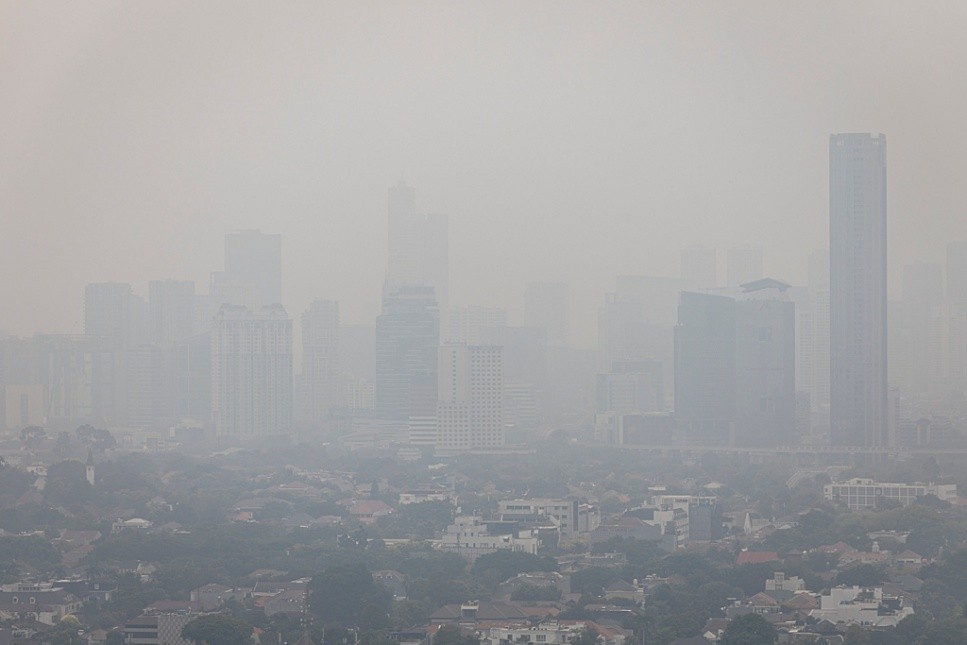
<p><img src="/assets/skyline-jakarta.jpg" style="float: right; width:60%; margin-left: 15px" alt="A city skyline obscured by heavy smog. Smaller residential buildings are visible in the foreground, with greenery dotted about. High-rise buildings stand at the back, barely visible through the cloud." /></p>

<p>Pollution is the largest environmental cause of avoidable disease, disability and premature death in the world today<sup id="fnref:1" role="doc-noteref"><a href="#fn:1" class="footnote" rel="footnote">1</a></sup>. Air pollution is responsible for almost 75% of the 9 million pollution deaths globally each year<sup id="fnref:2" role="doc-noteref"><a href="#fn:2" class="footnote" rel="footnote">2</a></sup> with many millions more suffering from poor health. The death toll dwarfs that from road traffic deaths, HIV/Aids, malaria and TB combined, or from drug and alcohol misuse. The research data are complex and can appear contradictory. They must take account of both household (indoor) and ambient (outdoor) pollution and multiple sources of both anthropogenic and natural pollution, many of which interact and overlap and are changing rapidly over time and space. In most developed countries pollution is declining due to the ramping up of clean energy and legal frameworks restricting emissions.  In lower-income countries, whose economies have more recently been growing on the back of the fossil fuel energy sources that have already made developed countries so rich, they are rising. The overall trend is still upwards, mainly because of population growth and rapid industrialisation of low- and middle-income countries. For example, the area of land allocated to oil and gas production on the African continent is set to quadruple. Many of these exploration sites threaten 30% of dense tropical forests in Africa<sup id="fnref:3" role="doc-noteref"><a href="#fn:3" class="footnote" rel="footnote">3</a></sup>.</p>

<p>The WHO estimates that in 2019, some 68% of ambient air pollution-related deaths were due to ischaemic heart disease and stroke, 14% to chronic obstructive pulmonary disease, 14% to acute lower respiratory infections, and 4% to lung cancers<sup id="fnref:4" role="doc-noteref"><a href="#fn:4" class="footnote" rel="footnote">4</a></sup>. In addition to the health burden of ambient pollution, around 2.1 billion people worldwide (around a third of the global population) cook using open fires or inefficient stoves fuelled by kerosene, biomass (wood, animal dung and crop waste) and coal, which generates harmful household air pollution. More recent studies tend to find a higher death toll than earlier studies because new scientific evidence suggest that the health impacts of exposure to pollution are larger than previously thought. (For links to more information on different pollutants, their sources and their particular impact on human health, see <a href="#appendix">Appendix</a> below).</p>

<h2 id="how-has-this-come-about">How has this come about?</h2>

<p>The main cause of air pollution is the combustion of fossil fuels. This accounts for 85% of fine particulate air pollution and for almost all airborne emissions of sulphur oxides and nitrogen oxides. Fossil fuel combustion is also the major source of the greenhouse gases such as carbon dioxide and the short-lived climate pollutants that are the major drivers of climate change<sup id="fnref:1:1" role="doc-noteref"><a href="#fn:1" class="footnote" rel="footnote">1</a></sup>.  Behind this global public health crisis lies an economic model that fails to link development to social or economic justice or to stewardship of the planet. It is beyond the scope of this paper to discuss how the devastation of the earth’s ecosystems is attributable to the worldwide obsession with economic growth in Gross Domestic Product (GDP), due to its tight coupling with burning fossil fuels. (A paper exploring ways in which societies might bring about a just transition to sustainable economic growth is referenced below<sup id="fnref:5" role="doc-noteref"><a href="#fn:5" class="footnote" rel="footnote">5</a></sup>).</p>

<h2 id="multiple-injustices">Multiple Injustices:</h2>

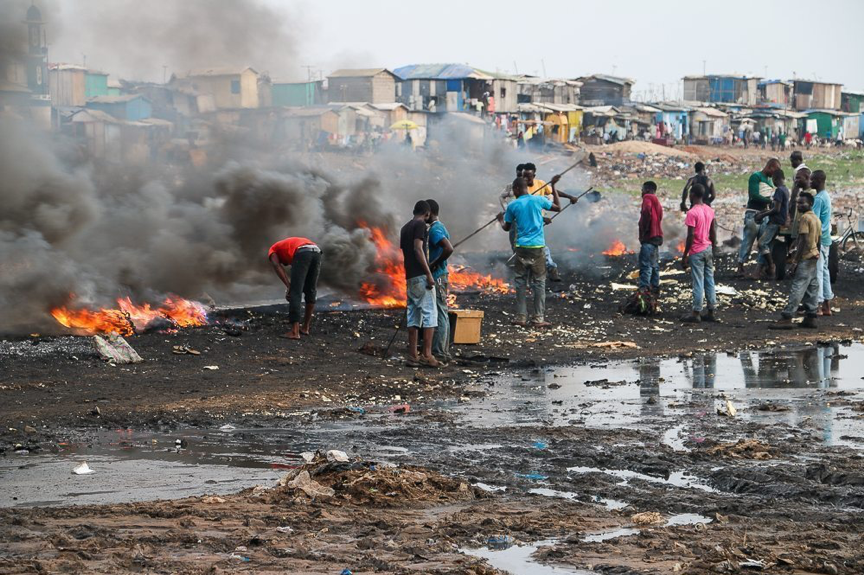
<p><img src="https://citinewsroom.com/wp-content/uploads/2021/09/picture1-1.png" style="float: left; width:60%; margin-right: 15px" alt="A group of black people stand in a muddy area, burning piles of something that looks like waste. They are using long poles to move material onto the fire. There are groups of ramshackle buildings visible in the background." /></p>

<p>For too long wealthy nations have plundered the earth’s natural and human resources through over-extraction, hyper-consumption and exploitation.  At the other end of their operations, negative ‘externalities’ such as unwanted wastes are released into the environment by producers who have taken no responsibility or shown any concern for how, where or whom they may harm - let alone shown willing to take remedial or mitigating measures, including compensation for the damage caused.</p>

<p>Just as the benefits of the rich industrialised nations’ economic development have been inequitably distributed, both within or beyond their boundaries, so the impacts of environmental degradation, pollution and climate change have also not been evenly distributed. They fall disproportionately heavily on countries who have done least to cause them. Approximately 89% of premature deaths occur in low- and middle-income countries, the heaviest toll being borne in the WHO regions of South-East Asia and Western Pacific.  Marginalised and disenfranchised communities and the indigenous peoples around the world are particularly affected. Often the most vulnerable groups are located near industrial plants, factories, roads and landfills, areas where pollution levels tend to be higher.  Women and children, typically responsible for household chores such as cooking and collecting firewood, bear the greatest health burden from the use of polluting fuels and technologies in homes. Household air pollution led to an estimated 3.2 million deaths in 2020 <sup id="fnref:6" role="doc-noteref"><a href="#fn:6" class="footnote" rel="footnote">6</a></sup>.  The scarcity of access to political power of poorer communities limits their ability to demand better environmental quality. Prioritising economic interests over public health in many government policies perpetuates and even increases inequalities.</p>

<p>The role of colonialism in the present crisis should also be recognised. During colonial rule, European powers extracted valuable resources from African nations without regard for their long-term economic development. Colonialists saw “new” territories as places with unlimited resources to exploit in the service of early modern state-making and capitalist development. For example, British colonial rulers in Nigeria focused on extracting oil, positioning Nigeria as one of Africa’s major oil producers. Nigeria’s economy remains heavily reliant on oil exports and faces the consequences of price fluctuations in global markets. The UN Development Programme has documented the economic instability that accompanies raw material dependency, noting that countries lacking the infrastructure to process their resources into higher-value products struggle with poverty and limited economic diversification 3. Approximately 40% of Nigerians live below the national poverty line.</p>

<p>Other African governments point to the double standards of countries in the global north that have grown rich on the back of fossil fuel development, whose per capita emissions far outstrip that of developing nations and who continue to expand their own fossil fuel operations – while seeking to dial back their financing of fossil fuels in developing countries.</p>

<h2 id="how-can-environmental-justice-be-promoted">How can environmental justice be promoted?</h2>

<p>Since the 1990s, governments have been enacting legislation imposing the cost of externalities on the producer. The right to a sustainable and healthy environment was acknowledged by the United Nations Human Rights Council in October 2021 and subsequently by the UN General Assembly in 2022.  However, the steady stream of court cases brought by indigenous communities and environmental defenders is evidence of how far these rights are from this being universally accepted and practiced. At successive climate COPs, rich countries, whose industrial economies have brought previously unimagined material riches, have resisted taking responsibility for the environmental impacts of their wealth.</p>

<p>It surely must be the responsibility of both governments and business organisations to implement policies of accountability, mitigation and reparation for harms done in the pursuit of profits and to adopt an inclusive culture of community participation in decisions that affect the lives of peoples in their zones of operation. And for all of us as individuals, to lobby for such change and to ensure that we are educated and vigilant about the pollution footprint of what we use and consume so that we reduce our own harms as far as possible. As Wendell Berry writes “The only questions we have a right to ask is what’s the right thing to do? What does the earth require of us if we want to continue to live on it?”</p>

<p>Christian teaching is very clear about the response that we must make. We cannot enjoy the spirituality that truly is of God unless we are engaged in the struggle for justice, love and compassion in the world. Matthew’s gospel is explicit – and it is exacting. Jesus tells his disciples that in failing to care for ‘the least of their brothers and sisters’, they are failing to care for Him. When we are in wrong relation with one another, with Creation and the Spirit that connects us, we separate ourselves from God and are effectively ‘broken’.  It seems that we must do nothings less than die to the old life and be reborn in the new. Or as Joanna Macy puts it “Of all the dangers we face .. none is so great as the deadening of our response.. We are going to have to want different things, seek different pleasures, pursue different goals than those that have been driving us and our global economy.”</p>

<p>How are we to meet this challenge? How are we to ensure that our love for the God-given gift of Creation is activated to work for justice for all?</p>

<p>When we come to breathe our last… God have mercy</p>

<h2 id="appendix">Appendix</h2>

<p>Notes on Pollution:</p>
<ul>
  <li><strong>Particulate matter (PM)</strong> - is a common proxy indicator for air pollution. There is strong evidence for the negative health impacts associated with exposure to this pollutant. The major components of PM are sulphates, nitrates, ammonia, sodium chloride, black carbon, mineral dust and water.</li>
  <li><strong>Carbon monoxide (CO)</strong> - is a colourless, odourless and tasteless toxic gas produced by the incomplete combustion of carbonaceous fuels such as wood, petrol, charcoal, natural gas and kerosene.</li>
  <li><strong>Ozone (O3)</strong> - Ozone at ground level – not to be confused with the ozone layer in the upper atmosphere – is one of the major constituents of photochemical smog and it is formed through the reaction with gases in the presence of sunlight.</li>
  <li><strong>Nitrogen dioxide (NO2)</strong> -  is a gas that is commonly released from the combustion of fuels in the transportation and industrial sectors.</li>
  <li><strong>Sulphur dioxide (SO2)</strong> - is a colourless gas with a sharp odour. It is producd from the burning of fossil fuels (coal and oil) and the smelting of mineral ores that contain sulphur.</li>
</ul>

<p>Further information on the specific health impacts of particular pollutants can be found in the table here <a href="https://pmc.ncbi.nlm.nih.gov/articles/PMC10472068/table/tbl1/">https://pmc.ncbi.nlm.nih.gov/articles/PMC10472068/table/tbl1/</a> and its paper here <a href="https://pmc.ncbi.nlm.nih.gov/articles/PMC10472068/">https://pmc.ncbi.nlm.nih.gov/articles/PMC10472068/</a></p>

<h3 id="images">Images</h3>

<ul>
  <li>Buildings are seen shrouded in smog in Jakarta, Indonesia. Millions of residents of Jakarta suffer from some of the worst air pollution in the world.
    <ul>
      <li>Mandatory Credit: Aji Styawan / Climate Visuals</li>
    </ul>
  </li>
  <li>Burning site, Agbogbloshie Ghana.
    <ul>
      <li>Mandatory credit:  Fairphone.</li>
    </ul>
  </li>
</ul>

<h2 id="footnotes">Footnotes</h2>

<div class="footnotes" role="doc-endnotes">
  <ol>
    <li id="fn:1" role="doc-endnote">
      <p><a href="https://doaj.org/article/147004dd79d64ef7948ed47ce4f0c75e">https://doaj.org/article/147004dd79d64ef7948ed47ce4f0c75e</a> <a href="#fnref:1" class="reversefootnote" role="doc-backlink">&#8617;</a> <a href="#fnref:1:1" class="reversefootnote" role="doc-backlink">&#8617;<sup>2</sup></a></p>
    </li>
    <li id="fn:2" role="doc-endnote">
      <p><a href="https://www.thelancet.com/journals/lanplh/article/PIIS2542-5196(22)00090-0/fulltext">https://www.thelancet.com/journals/lanplh/article/PIIS2542-5196(22)00090-0/fulltext</a> <a href="#fnref:2" class="reversefootnote" role="doc-backlink">&#8617;</a></p>
    </li>
    <li id="fn:3" role="doc-endnote">
      <p><a href="https://www.rainforestfoundationuk.org/wp-content/uploads/2022/11/Congo-in-the-Crosshairs-Report-EN.pdf">https://www.rainforestfoundationuk.org/wp-content/uploads/2022/11/Congo-in-the-Crosshairs-Report-EN.pdf</a> <a href="#fnref:3" class="reversefootnote" role="doc-backlink">&#8617;</a></p>
    </li>
    <li id="fn:4" role="doc-endnote">
      <p><a href="https://www.who.int/news-room/fact-sheets/detail/ambient-(outdoor)-air-quality-and-health">https://www.who.int/news-room/fact-sheets/detail/ambient-(outdoor)-air-quality-and-health</a> <a href="#fnref:4" class="reversefootnote" role="doc-backlink">&#8617;</a></p>
    </li>
    <li id="fn:5" role="doc-endnote">
      <p><a href="https://www.thelancet.com/journals/lanplh/article/PIIS2542-5196(24)00310-3/fulltext">https://www.thelancet.com/journals/lanplh/article/PIIS2542-5196(24)00310-3/fulltext</a> <a href="#fnref:5" class="reversefootnote" role="doc-backlink">&#8617;</a></p>
    </li>
    <li id="fn:6" role="doc-endnote">
      <p><a href="https://www.who.int/news-room/fact-sheets/detail/household-air-pollution-and-health">https://www.who.int/news-room/fact-sheets/detail/household-air-pollution-and-health</a> <a href="#fnref:6" class="reversefootnote" role="doc-backlink">&#8617;</a></p>
    </li>
  </ol>
</div>]]></content><author><name>Penelope Turton</name></author><category term="breathe" /><summary type="html"><![CDATA[Air is the primary medium in which we live and move and have our being. The newborn baby’s first gasping, spluttering breath signals she is alive in the world. It is through air that we savour the scents of the natural world, feel the warmth of the sun and the freshness of the breeze and sense the shifts in the weather and the season. With every breath we take and release we are in direct relationship with the ecosystem that sustains us. And “as we come to breathe our last” we die.]]></summary></entry><entry><title type="html">Eco Contemplative Liturgy: Con-spiring Together: Breathing for Justice</title><link href="sjpearthjustice.github.io/breathe/liturgy/2024/11/24/eco-cont-lit.html" rel="alternate" type="text/html" title="Eco Contemplative Liturgy: Con-spiring Together: Breathing for Justice" /><published>2024-11-24T00:00:00+00:00</published><updated>2024-11-24T00:00:00+00:00</updated><id>sjpearthjustice.github.io/breathe/liturgy/2024/11/24/eco-cont-lit</id><content type="html" xml:base="sjpearthjustice.github.io/breathe/liturgy/2024/11/24/eco-cont-lit.html"><![CDATA[<p><i style="text-align: center">
This liturgy draws gratefully on Dr Laurel Kearns’s work with excerpts from her inspirational chapter ‘Con-spiring Together: Breathing for Justice’ from ‘The Elements: The Bloomsbury Handbook of Religion and Nature’, published by Bloomsbury Publishing in 2018.</i></p>

<p><img src="/assets/clouds.jpg" style="display: block; margin-left: auto; margin-right: auto; width: 30%;" alt="White clouds in a blue sky." /></p>

<h2 id="gathering">Gathering</h2>

<p>We take a few moments to arrive in our chosen space, settling into a comfortable position.</p>

<p><em>Laurel writes ‘Take a deep breath… a deep breath of God’s breath, of plant and animals, of each other’s breath. Exhale it slowly…. You have just engaged in an interspecies ritual of communion. Now take another one, after all our lives depend on it. Just like we recognise how essential it is to breathe, we must recognise that air is sacred, it is the essence of life.’</em></p>

<h2 id="readings">Readings</h2>

<p><strong>Theophilus of Antioch, a 2nd century Christian writer</strong></p>

<p>“God has given to the earth the breath which feeds it. It is God’s breath that gives life of all things. And if God were to withhold it, everything would be annihilated. God’s breath vibrates in your breath, in your voice. It is the breath of God that you breathe.”</p>

<p><strong>Saying from The Upanishads, an ancient sacred Hindu text</strong></p>

<p>“Fire is His head, the sun and moon His eyes, space His ears, the Vedas His speech, the wind His breath, the universe His heart. From His feet the Earth has originated. Verily, He is the inner self of all beings.”</p>

<p><em>Take a breath… a deep breath… If it is clean air, give thanks for it. Exhale it slowly….</em></p>

<p><strong>Bad Air, Excerpt from UltraViolet by Joshua Bennet</strong></p>

<p>…So, no, my house doesn’t have solar panels on the roof,<br />
my parents don’t own a hybrid automobile<br />
I never really considered myself an environmentalist<br />
until the day I realised that it is all connected<br />
the neighbourhoods that host toxic waste facilities<br />
are almost always communities of colour<br />
the chemicals in the water that make our little girls look grown<br />
before they are old enough to deal with the consequences<br />
my little brother can’t run quite as fast<br />
as I could when I was his age<br />
because the smog has its fingers pressed firmly around his windpipe<br />
until the day we can exhale away this pain<br />
you will hear my voice cascading across the sky<br />
unmistaken as the sound of a crashing pesticide plane<br />
begging Mother Earth<br />
to have mercy on her children.</p>

<p>In our city of London, the need for clearer air is an environmental, social and racial justice issue too. London’s most deprived communities are still most likely to live in the most polluted areas of the city. In 2019, in the most deprived areas, the average Nitrogen dioxide concentration was 4.4 micrograms per cubic meter higher than in the least deprived areas. On average, in London’s diaspora communities, average Nitrogen dioxide levels were 8.1% higher than the London-wide average.<br />
(Data from ‘Air Pollution and Inequalities in London’ report, London City Hall, June 2023)</p>

<p><em>Laurel writes ‘Take a deep breath, a deep breath of air. Exhale it slowly… Now take another one, after all, our lives depend on it. Just like we do not willingly stop breathing, we are not going to give up, we refuse to be numb, to collapse into despair. That will get us nowhere. Each breath contains the elements of life, and now of our destruction. Do not let the latter take your breath away.’</em></p>

<h2 id="contemplative-time">Contemplative Time</h2>
<p>Spend 15 minutes in the Southwood Garden or wherever we are.</p>

<h2 id="regathering">Regathering</h2>
<p>There is time to share a few words about your time of contemplation, if you wish to.</p>

<h2 id="prayer-of-con-spiring-by-laurel-kearns">Prayer of Con-Spiring by Laurel Kearns</h2>

<p>O God who is above us and below us,<br />
around us and inside us with each breath we take,<br />
we thank you for the Breath of Life.<br />
From the very beginning we are told,<br />
your Breath, your ruach, your presence enlivens the world<br />
and brings all of creation to life.</p>

<p>All creatures exchange your Breath with the trees and plants,<br />
thousands of times each day,<br />
con-spiring together, breathing together,<br />
participating in an interspecies ritual of communion with you,<br />
reminding us of the sacred gift of life.</p>

<p>We have been taught to recognise the body and blood of Christ<br />
in the everyday world of grains and grapes.<br />
May we now learn to sense your presence<br />
in every breath we take so that we understand that<br />
when we dirty the air,<br />
when our actions make it so others cannot breathe,<br />
when we make the creation warm too much,<br />
we stifle your presence, we defile the Breath.</p>

<p>Let us vow that in our life’s limit of breaths,<br />
we make it so no one has to say, “I can’t breathe.”<br />
Let us vow that in our life’s limit of breaths<br />
our breathmates, the trees, can live and thrive.</p>

<p>O God of Breath,<br />
may each breath we take together -<br />
our con-spiring with each other and the forest –<br />
may it clear our minds and hearts.<br />
May it enliven our vision with justice and compassion.<br />
May it reconnect us with the creation<br />
so that we strive to truly live in communion<br />
with all living beings on this one earth.</p>

<p>And so, with each breath –</p>

<p>(<em>We say the Hebrew name of God as we breathe in and out</em>)</p>

<p>YAHHH WEHHH<br />
YAHHH WEHHH</p>

<p>– We remember that life is sacred.</p>

<h2 id="closing-prayer">Closing Prayer</h2>

<p><strong>Excerpt from Black Liturgies by Cole Arthur Riley</strong></p>

<p>It’s a season of unmasking, of veils lifted. We are seeing our collective soul with a clarity that is disorientating. Listen for the apathy, the cruelty and neglect. Then listen closely for all who dare resist.</p>

<p>INHALE<br />
Every breath sacred.</p>

<p>EXHALE<br />
Every face sacred.</p>

<p><strong>Amen</strong></p>]]></content><author><name>Zoe Cuckow</name></author><category term="breathe" /><category term="liturgy" /><summary type="html"><![CDATA[This liturgy draws gratefully on Dr Laurel Kearns’s work with excerpts from her inspirational chapter ‘Con-spiring Together: Breathing for Justice’ from ‘The Elements: The Bloomsbury Handbook of Religion and Nature’, published by Bloomsbury Publishing in 2018.]]></summary></entry></feed>